What Does a Halbach Array Actually Do in a Motor?
Hold-back with Halbach — what the array really changes in a motor.
Halbach arrays come up often when discussing permanent magnet motors, and the basic idea is quite elegant. By changing the magnetization direction of the individual magnets, we can concentrate the magnetic field toward one side of the array while reducing it on the other.
This can potentially let us reduce the amount of iron required in the rotor while still maintaining a strong air-gap field. But I wanted to understand what actually changes when a Halbach array is used in a motor:
- Does it increase the back EMF?
- Does it increase torque?
- Does it prevent demagnetization?
- Can we reduce the rotor back iron?
- Does it improve efficiency?
Or is the main advantage simply that we can achieve the required magnetic field with less rotor iron? To find out, I compared a conventional SPM motor with a Halbach-array SPM motor using electromagnetic FEA.
What is a Halbach array?
I'll skip the basics here since most readers already know what a Halbach array is. If you don't, read the Wikipedia overview, or watch this video (at 1.25× while reading the blog).
Conventional SPM vs Halbach array
For this comparison I designed three motors:
- Conventional SPM
- Halbach-array SPM
- Halbach-array SPM with lower rotor back iron
To keep the comparison fair, the conventional SPM was a SPM with 100% magnet embrace, and for the motor with Halbach, 20% of each magnetic pole was replaced by a motor as it is visible from the below figure:
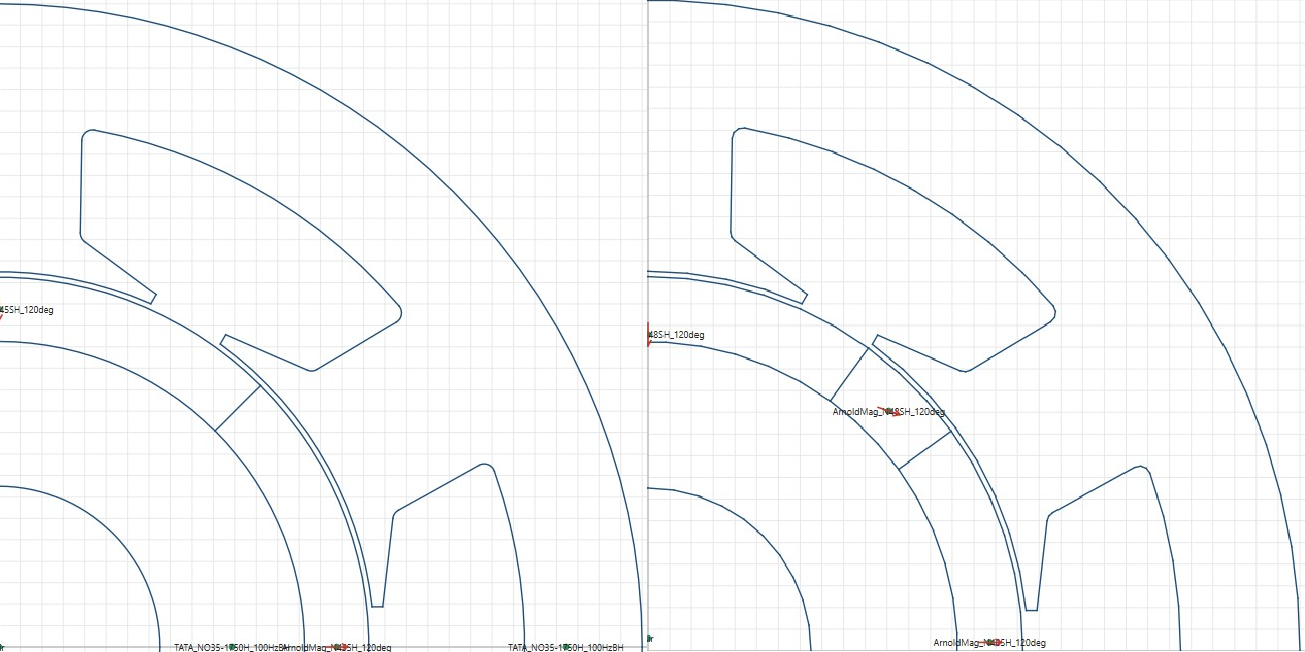
The idea was to keep the two motors as similar as possible and then compare their electromagnetic performance. The main parameters were:
| Parameter | Conventional SPM | Halbach SPM | Halbach (thin back iron) |
|---|---|---|---|
| Number of slots | 6 | 6 | 6 |
| Number of poles | 4 | 4 | 4 |
| Magnet material | N45SH | N45SH | N45SH |
| Magnet volume | 59376 mm² | 59376 mm² | 59376 mm² |
| Air gap | 0.5 mm | 0.5 mm | 0.5 mm |
| Rotor diameter | 69 mm | 69 mm | 69 mm |
| Speed | 3000 rpm | 3000 rpm | 3000 rpm |
| Rotor back iron | 13.5 mm | 13.5 mm | reduced |
The main difference between the designs is the magnetization arrangement.
Magnetic field
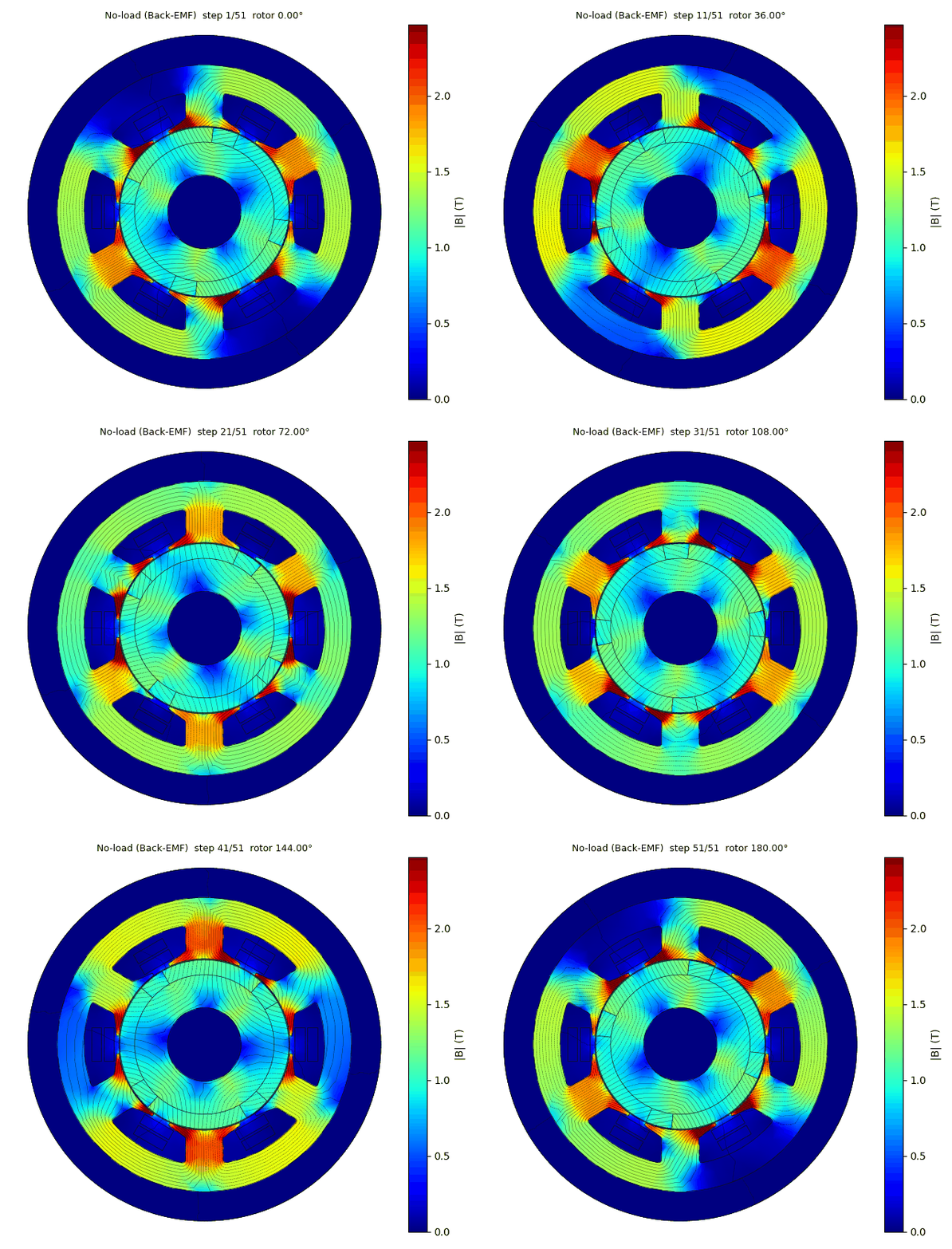
The first thing I wanted to look at was the magnetic field produced by the two rotors.
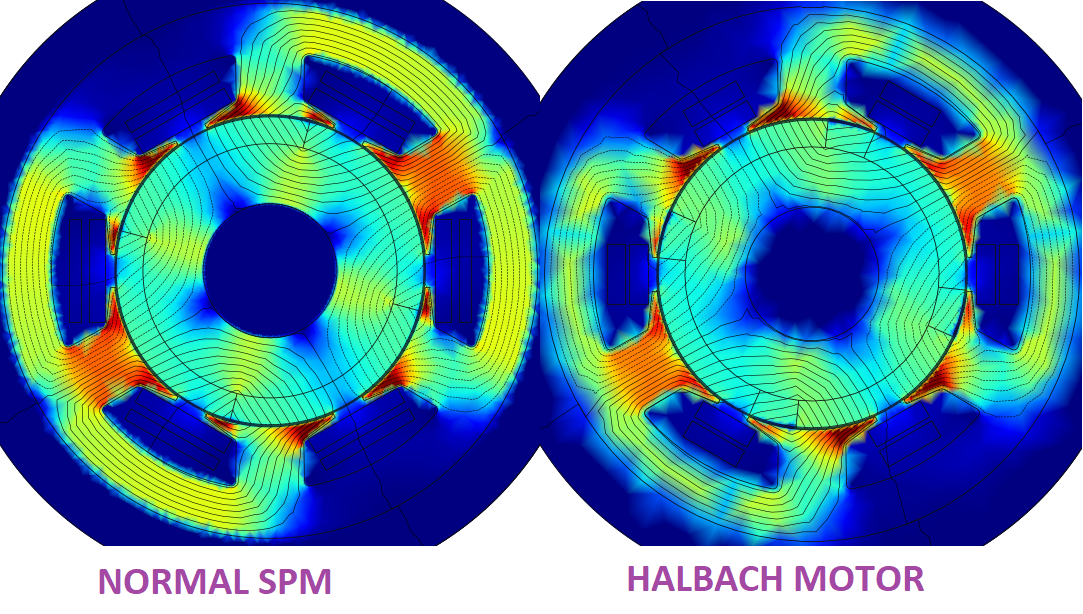
The difference in flux distribution is quite interesting. The Halbach arrangement concentrates more of the magnetic field toward the air gap while reducing the flux travelling toward the back of the rotor. This is one of the main reasons Halbach arrays are attractive for permanent magnet machines.
What happens to the back iron?
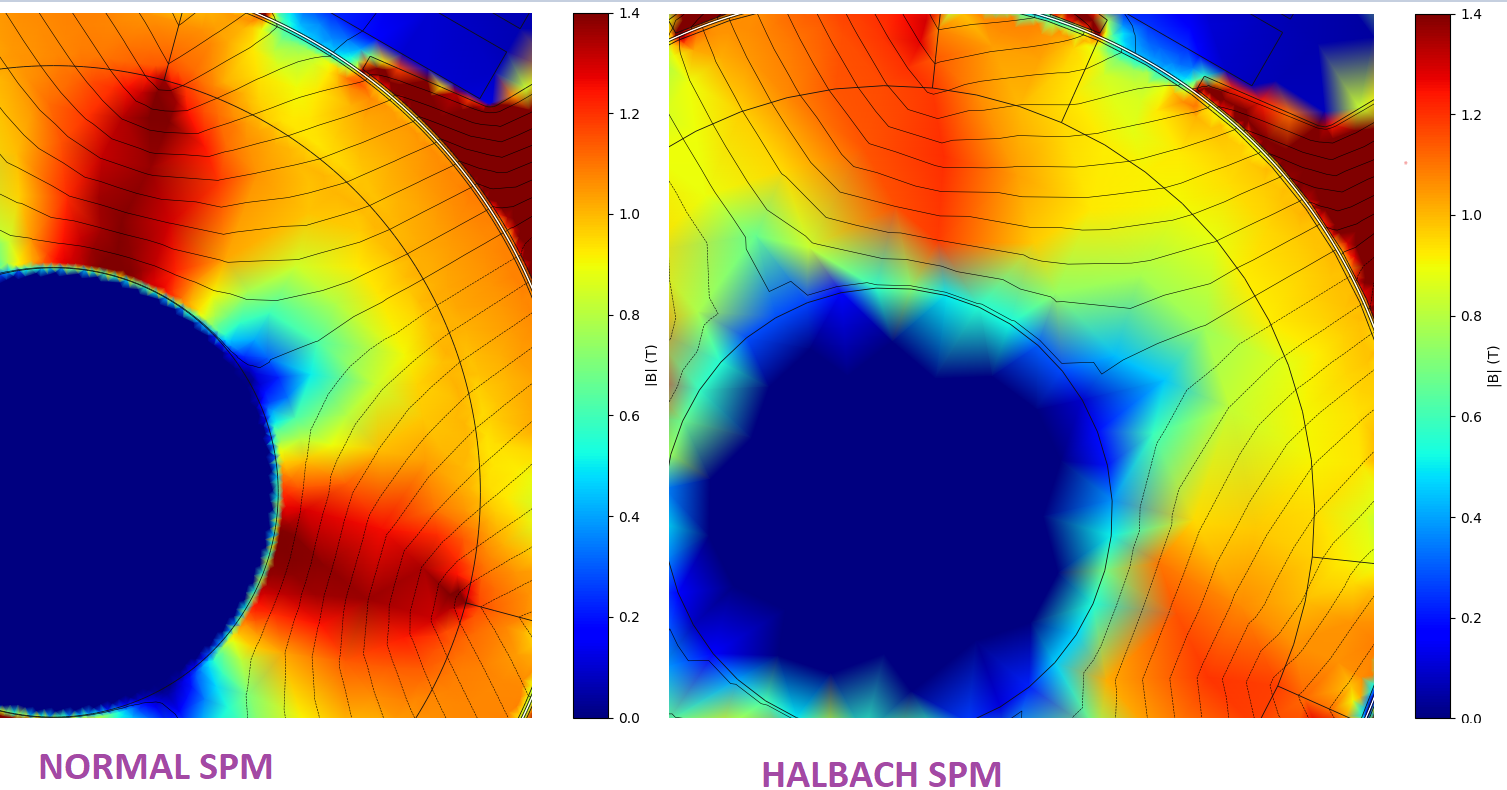
This was one of the main questions I wanted to investigate. In a conventional SPM motor the rotor back iron must provide a low-reluctance path for the magnetic flux; if it becomes too thin, it can saturate. With a Halbach array the field on the back side of the magnets is reduced, so less flux needs to pass through the rotor back iron — which means the back iron can potentially be made thinner.
What happens to back EMF?
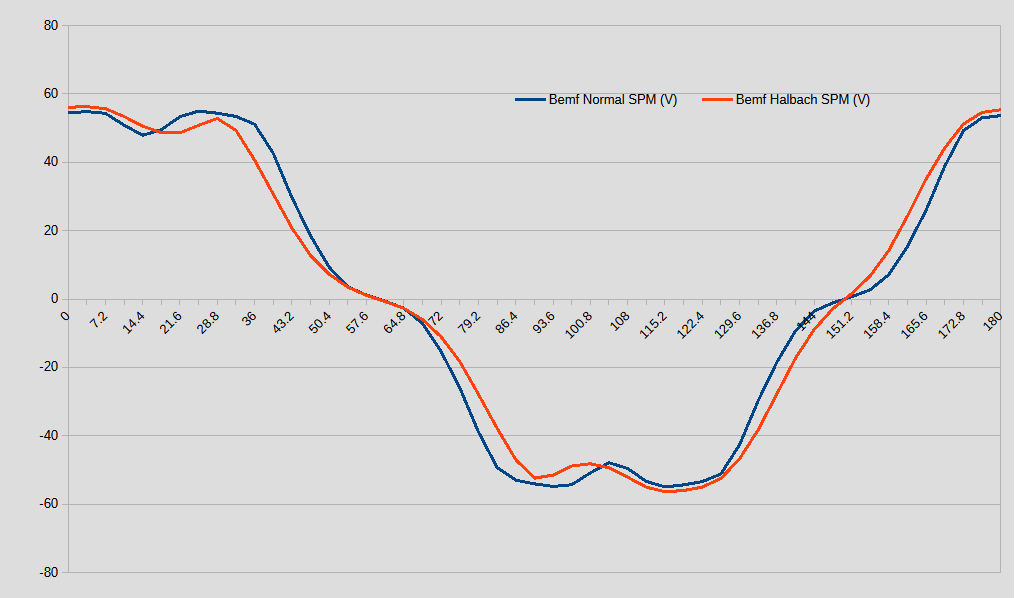
The next question was whether the Halbach array actually produces more useful air-gap flux, so I compared the back EMF of both motors.
| Parameter | Conventional SPM | Halbach SPM |
|---|---|---|
| RMS back EMF | 40.93 V | 40.43 V |
| Peak back EMF | 54.96 V | 56.34 V |
| THD | 15.25 % | 16.31 % |
The results were similar — in fact the Halbach motor had slightly lower RMS back EMF and slightly higher THD. This is an important point: a Halbach arrangement does not automatically mean a higher back EMF. The actual result depends on the magnet dimensions, magnetization arrangement, air gap and rotor geometry.
What about torque?
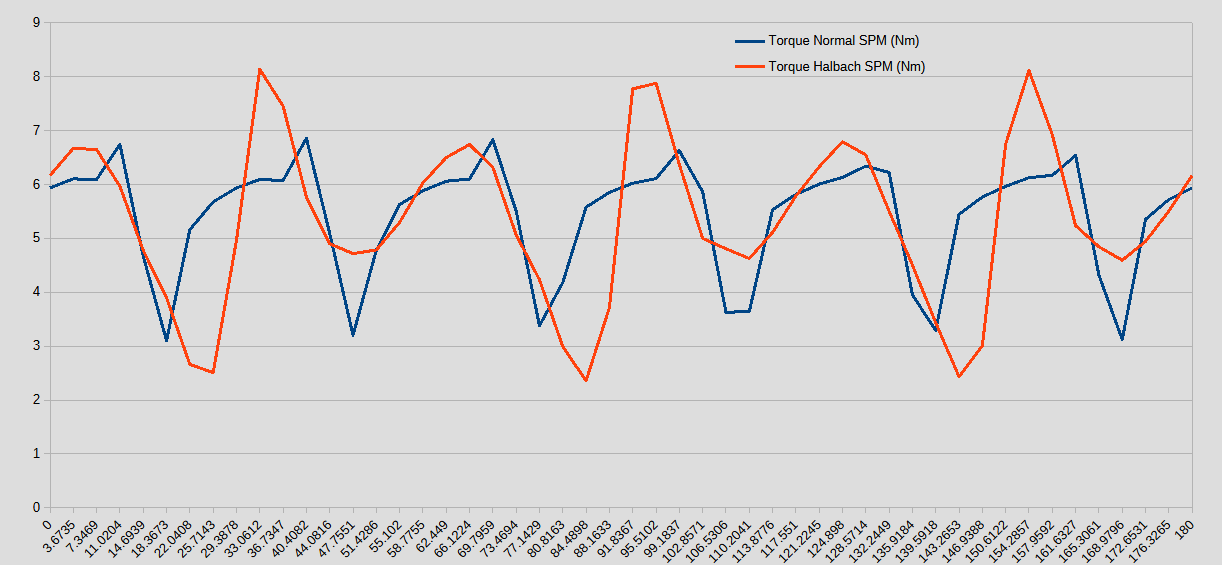
I then compared the torque produced by the two motors.
| Motor | Average torque | Torque ripple |
|---|---|---|
| Conventional SPM | 5.45 Nm | 3.75 Nm |
| Halbach SPM | 5.36 Nm | 5.78 Nm |
What's interesting here is not only the average torque but also the shape of the torque waveform. Changing the magnetization pattern changes the air-gap flux distribution, which can also change the harmonic content of the air-gap field — and therefore the torque ripple.
So, does a Halbach array improve the motor?
After running these simulations, I think the more useful way to look at a Halbach array is not:
"Does a Halbach array give more performance?"
but instead:
"What part of the motor can we change because of the Halbach arrangement?"
The Halbach array changes how the magnetic flux is distributed around the rotor. That can potentially let us:
- reduce rotor back iron
- reduce rotor mass
- reduce flux leakage toward the rotor
- increase the magnetic loading for a given rotor geometry
- change the magnet operating point
- potentially improve the demagnetization margin
At the same time, it does not automatically mean every performance parameter improves — the actual effect on back EMF, torque, losses and torque ripple depends on the specific design.
Conclusion
Halbach arrays are an interesting example of how changing the magnetization direction of permanent magnets changes the way magnetic flux is distributed inside a motor. In this study I compared a conventional SPM motor with a Halbach-array SPM motor. Rather than thinking of the Halbach array simply as a way of producing more flux, it's better to think of it as a way of controlling where the magnetic flux goes.
This can potentially allow the rotor to be designed with less back iron while maintaining the required electromagnetic performance. However, there are other considerations too — magnet segmentation, manufacturing complexity, magnetization requirements, mechanical strength and magnet losses. So whether a Halbach array is worthwhile ultimately depends on the particular application and design constraints.
About the simulation
The simulations in this article were performed using MotorDesignSoftware. You can import custom .dxf geometries and magnetize the magnets as needed, which is what made this conventional-vs-Halbach comparison straightforward to set up.
← Back to all articles