Magnet Eddy Current Losses — Does Motor Topology Matter?
SPM vs IPM, and how the slot/pole combination changes magnet losses.
When designing a permanent magnet motor, it is common to consider copper and core losses when calculating efficiency. However, depending on the motor topology and operating conditions, there can also be significant losses in the permanent magnets due to eddy currents.
I wanted to see how much these losses can actually vary between different motor designs, so I compared magnet eddy current losses in two ways:
- SPM vs IPM motors
- Different slot combinations for an SPM motor
What causes eddy current losses in magnets?
Permanent magnets are electrically conductive, so when they are exposed to a changing magnetic field, eddy currents can be induced inside them. These currents cause power losses and can also heat the magnets up. The magnitude of the loss depends on several factors, including:
- magnetic field harmonics
- electrical frequency
- magnet material
- magnet geometry
- rotor topology
- slot/pole combination
In this article I focus mainly on the effect of motor topology and slot/pole combination.
SPM vs IPM
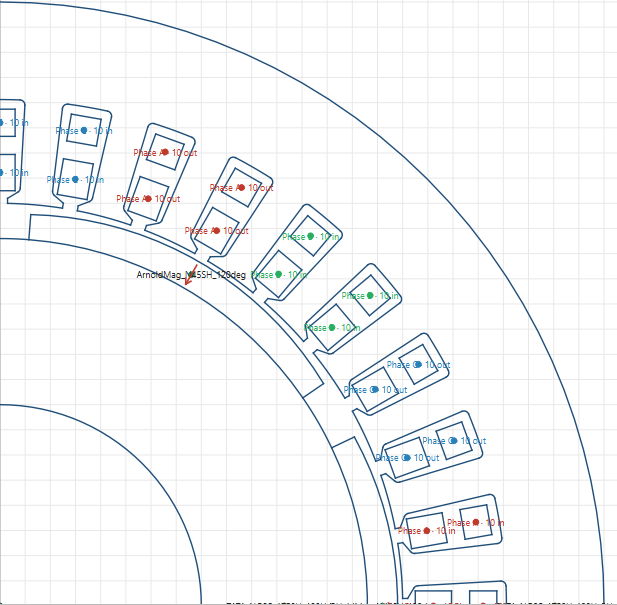
The first comparison was between a Surface Permanent Magnet (SPM) motor and an Interior Permanent Magnet (IPM) motor. The idea was to keep the designs as similar as possible and compare the magnet losses at the same operating condition.
SPM motor
IPM motor
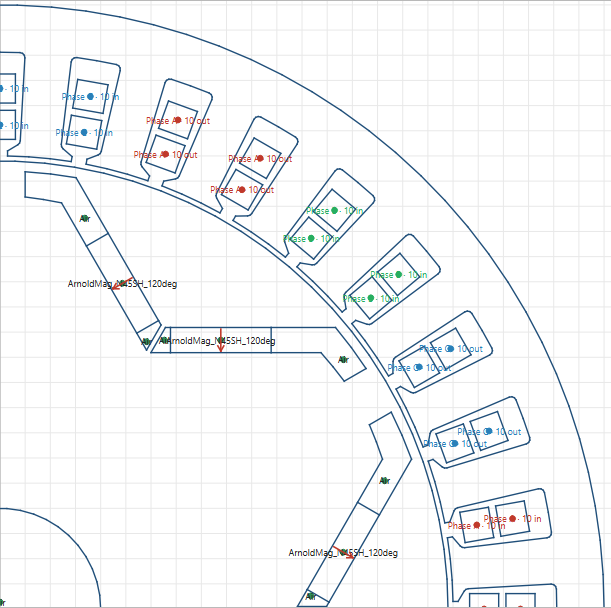
Because of this shielding, I expected the magnet eddy current losses to be lower in the IPM motor.
SPM vs IPM simulation
Simulation setup
For both motors I used the same stator, number of poles, operating speed, current, magnet material, and approximately the same magnet volume / dimensions. The motors were then simulated using time stepping, and the eddy current loss in the magnets was calculated from the resulting electromagnetic field.
Results
The difference between the two topologies is clear from the magnet loss distribution — the SPM motor shows considerably higher eddy current losses than the IPM. The total losses were:
| Motor | Magnet eddy current loss |
|---|---|
| SPM | 0.633 W |
| IPM | 0.36 W |
This isn't surprising when you look at the field the magnets see: the SPM magnets are directly exposed to the air-gap field and its harmonics, whereas the IPM magnets are tucked inside the rotor. That makes the IPM topology particularly attractive when magnet eddy current losses are a concern.
Effect of slot/pole combination
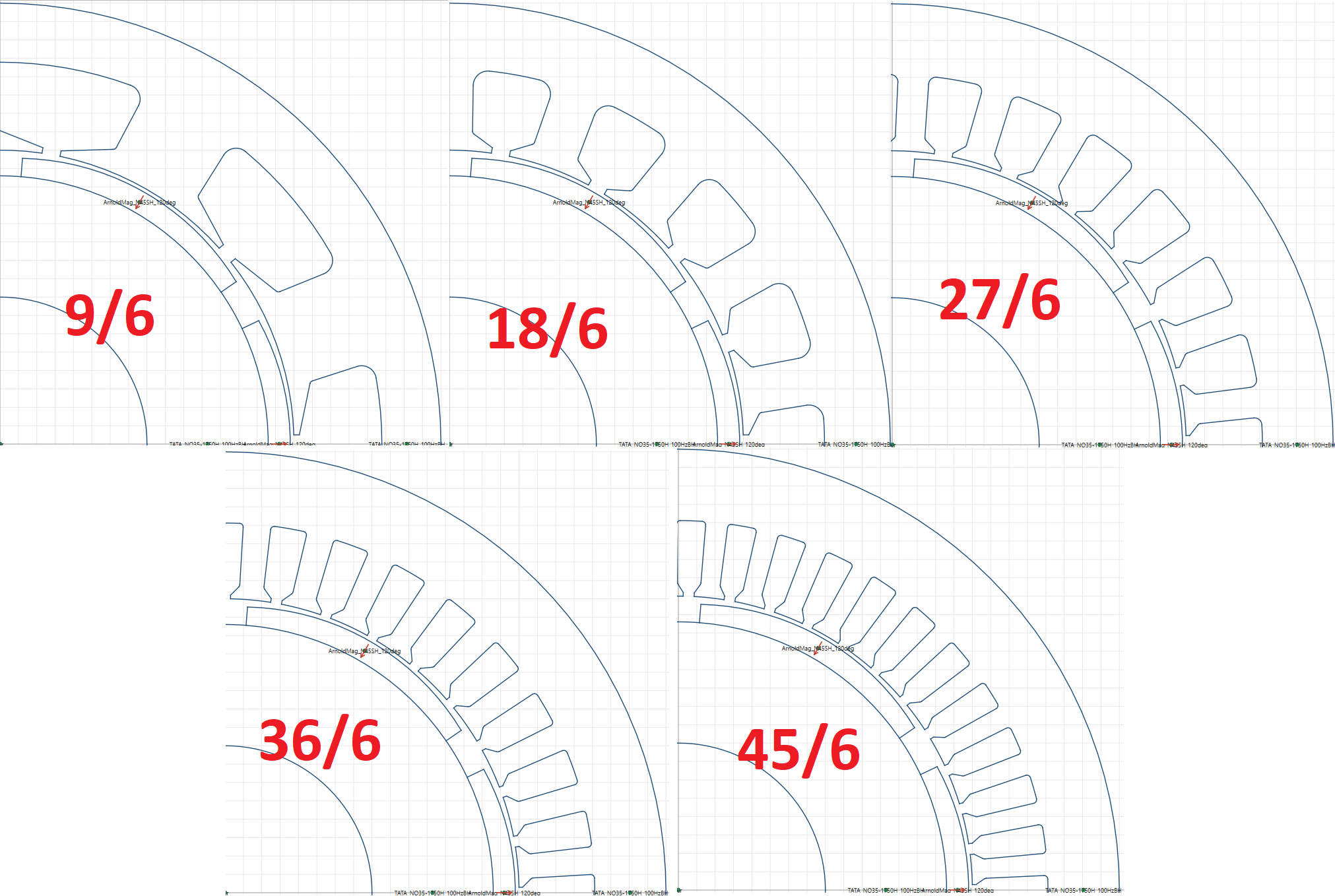
After comparing SPM and IPM, I wanted to answer another question: if we keep the rotor the same, how much can the magnet eddy current loss change just by changing the stator slot number? To investigate, I used a 6-pole SPM motor and compared several slot combinations — keeping the basic dimensions, magnet material, speed and operating point the same, and changing only the stator slots.
| Motor | Slots | Poles |
|---|---|---|
| Motor 1 | 9 | 6 |
| Motor 2 | 18 | 6 |
| Motor 3 | 27 | 6 |
| Motor 4 | 36 | 6 |
| Motor 5 | 45 | 6 |
Magnet eddy current loss
The resulting magnet losses were:
| Slot / pole | Magnet eddy current loss |
|---|---|
| 9 / 6 | 0.516 W |
| 18 / 6 | 0.62 W |
| 27 / 6 | 0.591 W |
| 36 / 6 | 0.633 W |
| 45 / 6 | 0.631 W |
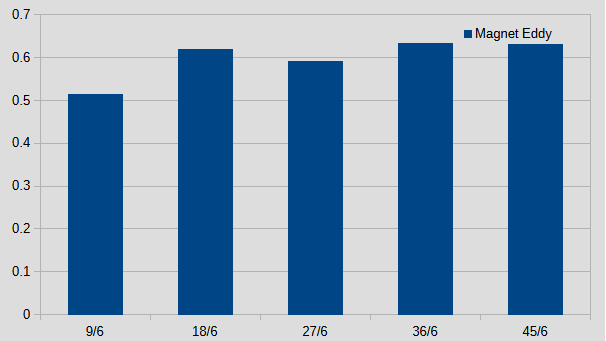
The difference is quite noticeable. Even though the rotor and operating conditions are identical, changing the stator slot combination changes the magnetic-field harmonics the magnets see — and so the magnet eddy current loss changes with it. This is interesting because the slot/pole combination is normally discussed in terms of winding factor, cogging torque, torque ripple and back-EMF harmonics; but it also affects magnet losses.
Why does this matter?
Magnet eddy current loss may not be the largest loss component in every motor, but it becomes more important for motors operating at:
- high speed
- high electrical frequency
- high magnetic loading
- high harmonic content
The results also show that magnet loss is not simply a property of the magnet material. Two motors using the same magnet material can have very different magnet losses depending on how the magnets interact with the field. For an SPM motor, the slot/pole combination is therefore another design parameter worth considering when trying to reduce magnet losses.
Conclusion
I compared magnet eddy current losses across different motor configurations. First, SPM vs IPM: the SPM motor showed significantly higher magnet eddy current losses because the magnets are directly exposed to the air-gap field. Then I compared different slot combinations for a 6-pole SPM motor — and even with the rotor and operating conditions held constant, changing the stator slot number changed the magnet losses.
This shows that magnet losses are affected not only by the magnet material and operating speed, but also by the motor topology and the harmonic content produced by the stator. When designing a high-speed permanent magnet motor, it is worth checking magnet eddy current losses rather than assuming they will be negligible.
About the simulation
The simulations in this article were performed using MotorDesignSoftware and FEMM. The software calculates magnet eddy current losses during time-stepping electromagnetic simulation and can be used to investigate how different motor geometries and operating conditions affect magnet losses.
- FEMM: femm.info/download
- MotorDesignSoftware: get a license
← Back to all articles