Where Does Motor Noise Come From?
Work hard in silence — don't let your motor be the noise.

When we talk about motor performance, we usually look at torque, efficiency, temperature and losses — but not so often at noise and vibration.
There are several possible sources of noise in an electric motor: mechanical effects, bearings, imbalance and electromagnetic forces. In this article I focus on the electromagnetic part — specifically, how air-gap magnetic field harmonics produce forces on the stator and rotor that can eventually result in motor noise and vibration.
Where does the noise come from?
The magnetic field in the air gap is not perfectly sinusoidal. Even if the motor is supplied with sinusoidal currents, the combination of:
- stator slots
- rotor geometry
- magnet shape
- winding distribution
- magnetic saturation
- operating conditions
can introduce harmonic components into the air-gap magnetic field. These harmonics produce a corresponding variation in the magnetic force acting across the air gap. That force acts on the stator structure and can make it vibrate. If one of these electromagnetic excitation frequencies is close to a mechanical resonance of the motor structure, the vibration can become significant — and be heard as noise. A simplified way of looking at the process is:
In this article I focus mainly on the first two parts.
Air-gap magnetic field
The first step is to calculate the magnetic field in the air gap. We can extract the radial and tangential components of the air-gap flux density as the rotor rotates. Axial components can also be considered depending on the analysis, although a 2D motor model focuses mainly on the radial and tangential field components.
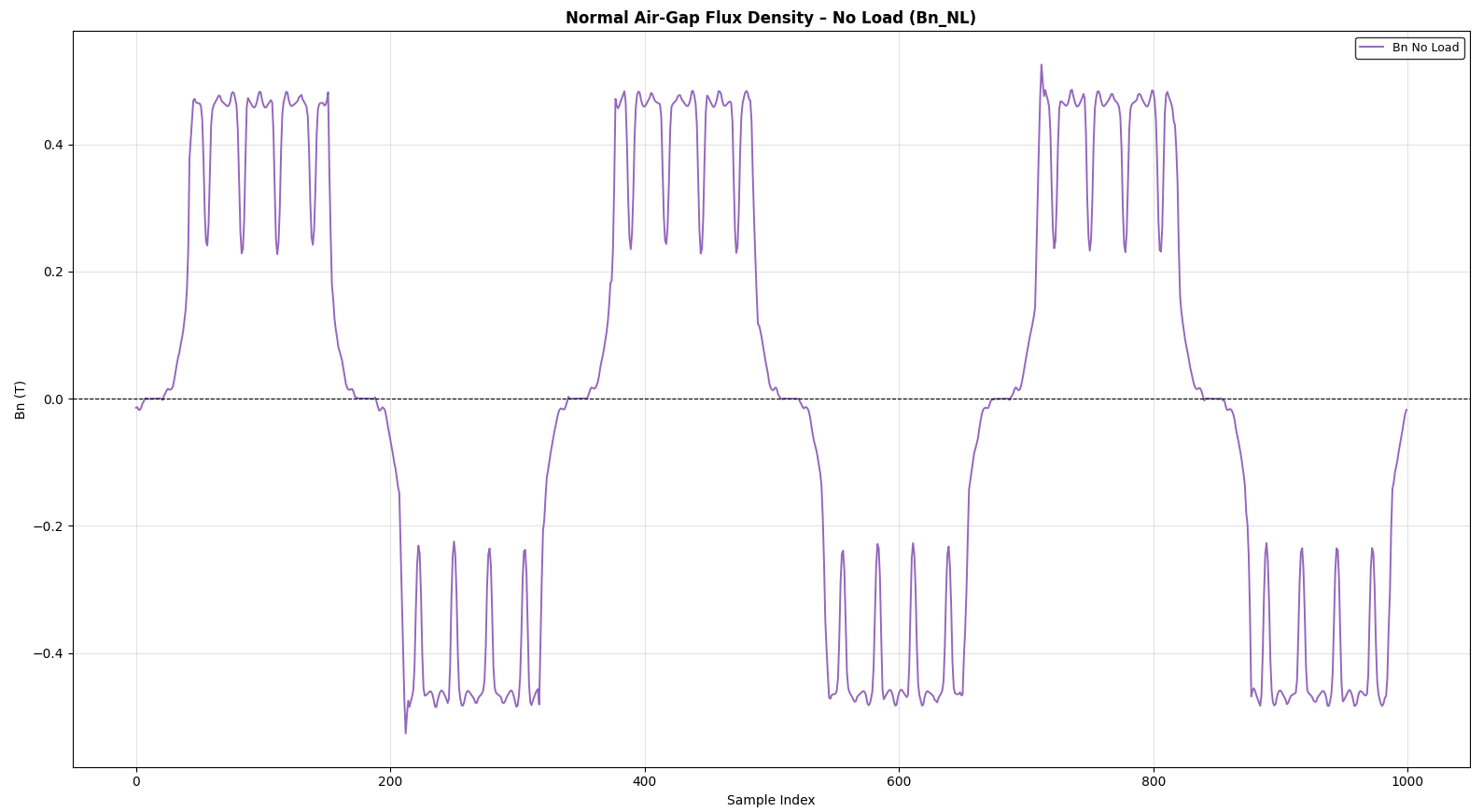
The waveform contains the fundamental as well as several harmonics. We then perform a Fourier analysis of the air-gap flux density to identify these harmonics, which tells us about the spatial and temporal harmonic content of the air-gap field.
From magnetic field to electromagnetic force
The magnetic pressure acting across the air gap is related to the square of the magnetic flux density. A simplified expression for the radial magnetic pressure is:
and for the tangential electromagnetic stress:
where pr is the radial magnetic pressure, pt is the tangential electromagnetic stress, Br and Bt are the radial and tangential components of the air-gap flux density, and μ0 is the permeability of free space.
This matters because even if the air-gap flux density contains certain harmonics, squaring the waveform produces additional force harmonics. These radial force waves act on the stator and are the electromagnetic excitation that can ultimately contribute to motor vibration and noise.
Force harmonics and modes of vibration
The electromagnetic force is characterized not only by its frequency but also by a spatial order — how the force is distributed around the circumference of the stator. A low spatial order produces a relatively simple deformation pattern, while higher spatial orders produce more complex patterns.
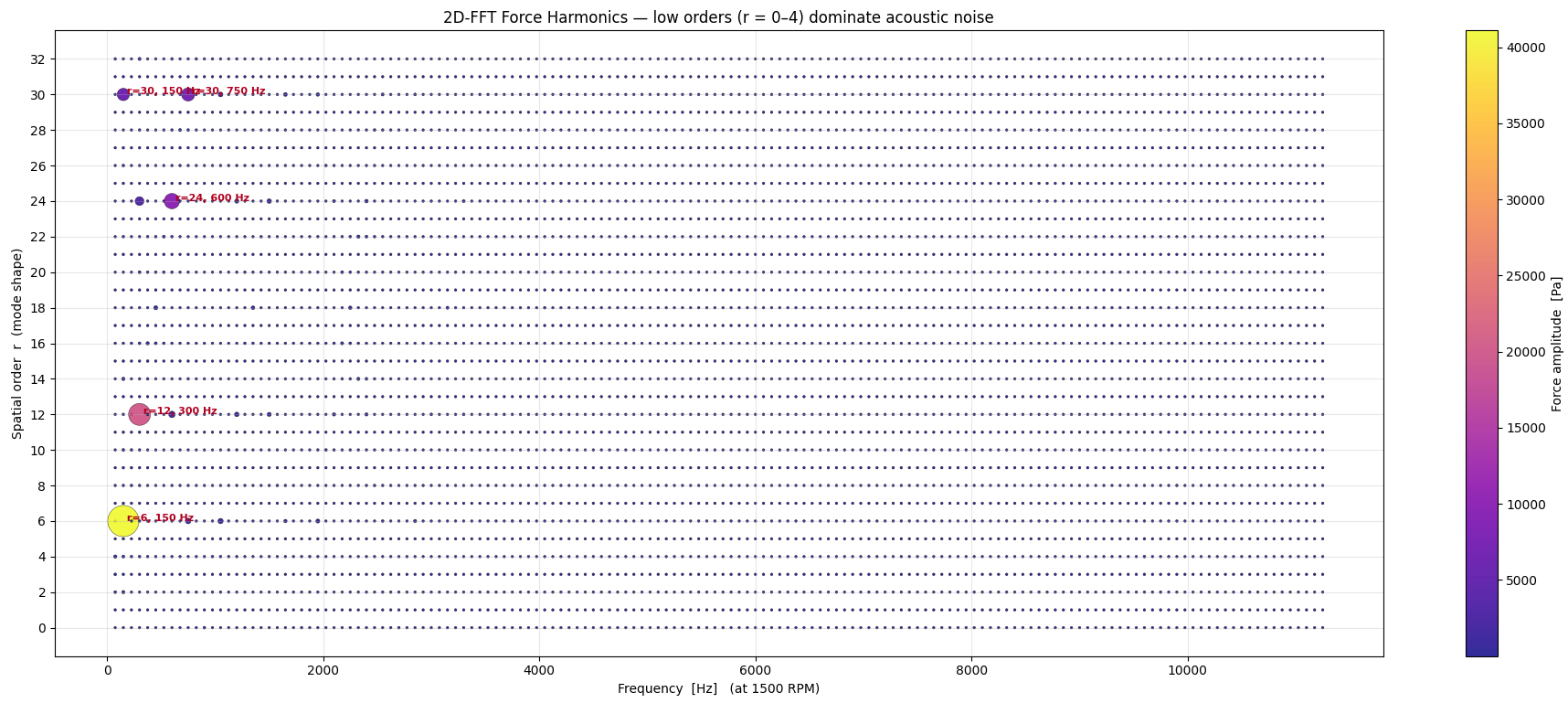
This is important because the stator does not respond equally to every spatial force pattern. The stator has its own natural modes of vibration, and different spatial orders excite different modes. In general, the lower-order structural modes are particularly important for motor noise because they produce larger-scale deformation of the stator and can couple strongly to the surrounding structure.
However, the actual vibration amplitude is not determined by mode order alone — it also depends on structural stiffness, modal mass, damping, and how closely the electromagnetic excitation frequency matches the natural frequency of the corresponding mode. So the electromagnetic analysis tells us which force harmonics are exciting the structure, while a structural analysis is needed to determine how strongly it actually responds.
How does MotorDesignSoftware calculate NVH?
The current NVH calculation in MotorDesignSoftware is based on this electromagnetic excitation. The software calculates the air-gap magnetic field from the electromagnetic FEA simulation and performs harmonic analysis on it. From that, we can identify the dominant air-gap harmonics and calculate the corresponding electromagnetic force components. This lets us investigate questions such as:
- Which harmonics are present?
- What are their amplitudes?
- At what frequencies do they occur?
- How does operating speed affect the excitation frequency?
- How does changing the motor geometry affect the harmonic content?
This is particularly useful when comparing different motor designs.
Is it accurate?
The calculation does not consider the complete picture. Its limitation is that the electromagnetic force alone does not directly tell us how loud the motor will be — the actual vibration and acoustic noise also depend on the motor's mechanical structure, including:
- stator stiffness
- stator natural frequencies
- rotor dynamics
- housing structure
- bearings
- mounting conditions
- damping
- acoustic radiation
Capturing all of that requires electromagnetic–structural coupling. The current MotorDesignSoftware calculation should therefore be considered an electromagnetic NVH analysis rather than a complete structural and acoustic NVH simulation — but its results give a good initial idea of the frequencies and modes likely to create the most noise. A full NVH analysis would look more like:
MotorDesignSoftware currently focuses on the first part of this chain.
Why is this still useful?
Even without the structural and acoustic analysis, looking at the electromagnetic excitation tells us a lot. If one motor design produces significantly larger force harmonics than another, that is useful information to have before moving to a detailed structural analysis. It also lets us investigate how electromagnetic design choices affect the excitation — for example:
- changing the slot/pole combination
- changing the magnet shape
- changing the winding distribution
- introducing skew
- changing the air gap
- changing the operating point
all affect the air-gap harmonics.
Conclusion
Motor noise is not caused by a single phenomenon. From an electromagnetic point of view, the non-sinusoidal air-gap field produces time-varying electromagnetic forces that can excite the mechanical structure and eventually result in vibration and acoustic noise. In MotorDesignSoftware we currently calculate the electromagnetic part of this problem by analysing the air-gap magnetic field and its harmonics — useful for comparing designs and spotting potentially problematic excitations. A complete NVH simulation would require additional structural and acoustic analysis to determine how the motor actually responds.
In a future article I'd like to use this approach to compare different slot/pole combinations and how they affect electromagnetic NVH behaviour, and to look at the effect of rotor eccentricity — since even a small amount can change the air-gap field and therefore the electromagnetic forces acting on the stator.
About the simulation
The NVH analysis described here is performed in MotorDesignSoftware, which calculates the air-gap magnetic field from an electromagnetic FEA simulation and analyses its harmonic content to identify the dominant electromagnetic force components.
- FEMM: femm.info/download
- MotorDesignSoftware: get a license
← Back to all articles